Ruy López’s lasting contribution was his opening analysis. The opening that bears his name offers a useful lesson for club players: a move becomes much easier to use when you understand what it is trying to achieve.
Knowing the first eight moves of an opening feels reassuring. Then your opponent plays something different on move four, and the remaining four moves are suddenly of very little use.
That is where understanding has to take over. Which pawn needs protecting? Which piece can improve? What was the next move meant to achieve in the first place?
Ruy López de Segura belongs in this discussion because his surviving work gives us something more useful than a famous name. His 1561 book examined opening choices and challenged earlier analysis. The contents of its modern English translation show whole sections exploring alternative ways to begin a game, alongside his criticism of Damiano’s ideas.
For this instalment of Boards of Fame, the lesson is to give your opening moves the same attention. The examples below are modern teaching positions, not games played by López or quotations from his book.
Start with the job of the move
The Ruy Lopez begins:
1.e4 e5 2.Nf3 Nc6 3.Bb5
White takes space in the centre with 1.e4 and opens lines for the queen and bishop. 2.Nf3 develops a knight while attacking Black’s e5-pawn. Black answers with 2…Nc6, developing a piece and defending that pawn.
Then comes 3.Bb5. White develops the bishop and attacks the knight defending e5.
That connection matters. The bishop is not simply visiting a square because the opening book says so. It is challenging a defender of the centre.
There is also a detail worth getting right: the knight is not pinned in this position. Black’s d7-pawn stands between it and the king. The bishop attacks the knight, but the knight can legally move.
You now have more than three moves to remember. You have a relationship between the pieces and pawns. That gives you something to work with when the game leaves your preparation.
An attacked defender does not mean a free pawn
The tempting conclusion is that White can exchange the bishop for the knight and collect e5. Try this:
1.e4 e5 2.Nf3 Nc6 3.Bb5 a6 4.Bxc6 dxc6 5.Nxe5
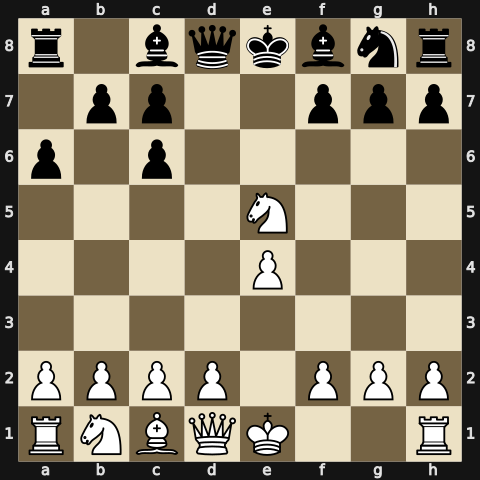
White has removed the defender and taken the pawn. Job done?
Black has 5…Qd4!, attacking both the knight on e5 and White’s pawn on e4. After 6.Nf3 Qxe4+, Black has recovered the pawn with check.
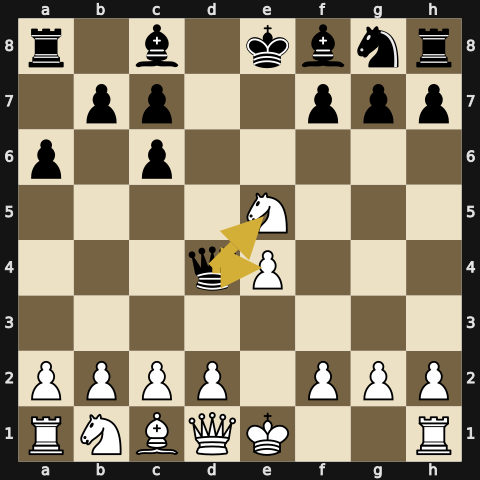
The capture on e5 did not win a clean extra pawn. Stopping the calculation immediately after taking it would give a misleading picture of the position.
This is a useful distinction for any opening. A piece may have no defender and still be protected by a tactical reply. Count the attackers and defenders, then look for checks, captures and threats after the exchange.
Nor does this make 4.Bxc6 a bad move. It begins the Exchange Variation, in which White changes Black’s pawn structure and gives up a bishop for a knight. That is a longer-term choice. It is not a guarantee of a free pawn on the next move.
Learn a plan alongside the sequence
White can also keep the bishop. Here is another route:
1.e4 e5 2.Nf3 Nc6 3.Bb5 a6 4.Ba4 Nf6 5.O-O Be7 6.Re1 b5 7.Bb3 d6 8.c3
There are already plenty of moves here to forget. Reduce them to their purposes.
White retreats the bishop to preserve it. Castling moves the king away from the centre and brings the rook into play. 6.Re1 supports e4. After Black expands with 6…b5, the bishop retreats again. 8.c3 prepares support for a later d4 pawn advance.
These moves work together. White is developing, protecting the centre and preparing to challenge it further.
The sequence is an example, not a set of instructions to follow regardless of Black’s replies. If Black changes the position, the priorities may change too. A threat to your queen takes precedence over the pawn move you were hoping to play.
Knowing the plan gives you a starting point. Checking your opponent’s move tells you whether the plan still fits.
Give the other side a proper move
López’s book examined and disputed earlier opening analysis. There is a practical habit worth taking from that: test an idea against a reply that could spoil it.
In the first example, White’s idea looks convincing until Black finds …Qd4. If you only investigate a quiet developing move for Black, you miss the whole point.
Use the same standard when studying your own repertoire. After choosing a move, turn the board around. Look for your opponent’s most awkward check, capture or threat. If the idea survives that, continue the analysis.
A line that works only when the opponent co-operates needs more work.
A short exercise for your next study session
Take one opening position from a recent game. Stop at the first move you played from memory without being able to explain it.
Write down three things:
- The purpose: what the move develops, protects, attacks or prepares.
- The reply: what your opponent can do to challenge that purpose.
- The next step: what you intend to do if the position allows it.
Then check your answer against a reliable opening source or an engine. If you use an engine, follow the line far enough to understand the reason for its verdict. A decimal number alone will not explain the mistake.
For the position after 5.Nxe5 above, the key reply is 5…Qd4. Remembering that double attack is more useful than remembering a warning that says ‘do not take the pawn’. You can recognise the idea when it appears somewhere else.
López’s place on the Founders Board rests heavily on what he left in writing. For a player studying today, that makes this a fitting lesson to take from his work: examine the move, test the reply and understand the position you are trying to reach.
The next time your opponent leaves the book, you will still have something to play for.
Read more: Ruy López de Segura: The Priest Behind the Opening · Madrid 1575: The First World Chess Championship That Wasn’t